

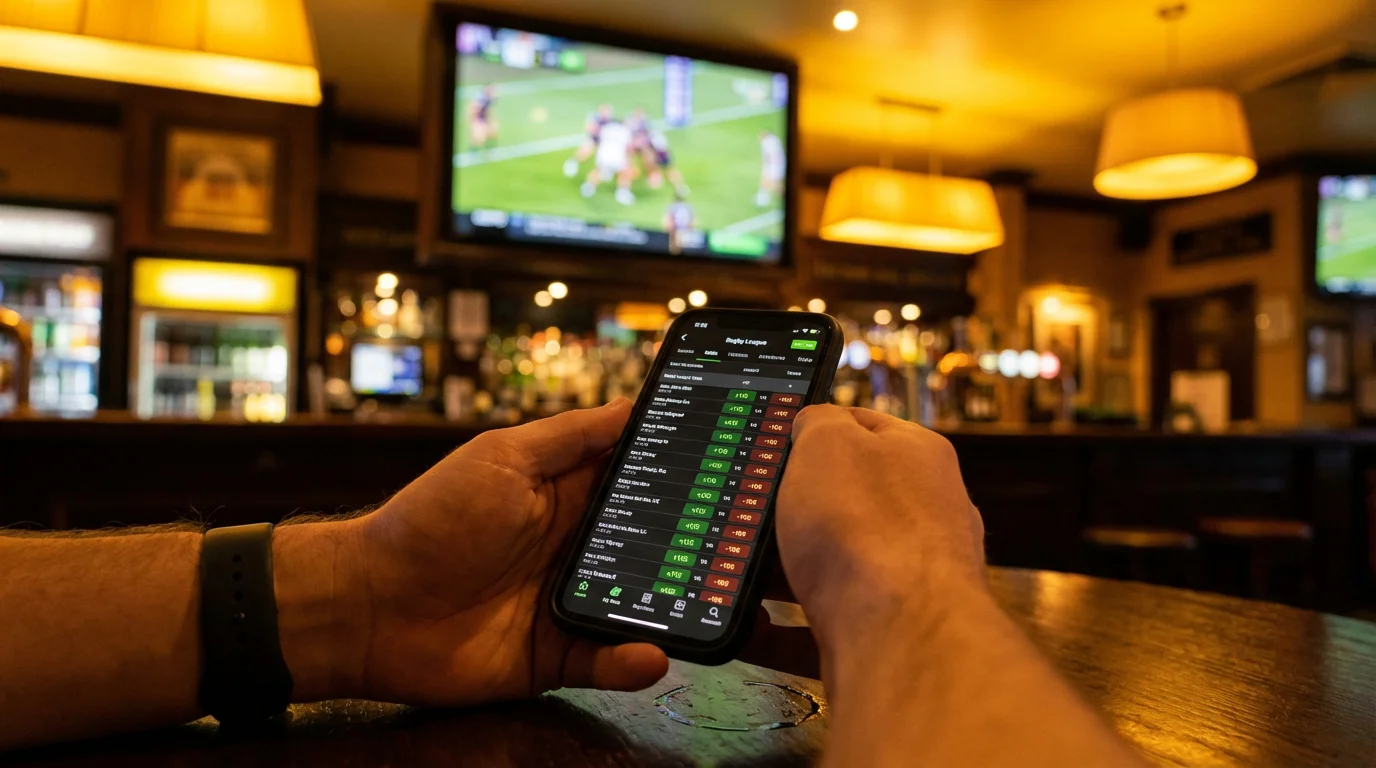

The odds you see when a market first opens are not the odds you will see at kickoff. Between the moment a bookmaker posts an opening line and the moment the referee blows the whistle, the price moves — sometimes a little, sometimes dramatically. That movement is not random. It is the visible trace of money entering the market, and learning to read it is one of the most useful skills a rugby league bettor can develop.
Line movement tells you what other bettors think, who those bettors are, and occasionally where the bookmaker’s own assessment has shifted. It is, in effect, a real-time information feed — free to anyone who pays attention. See also our live betting page.
Opening Lines and What They Represent
A bookmaker’s opening line is their first public statement about a match. It reflects the trading team’s assessment of the likely outcome based on available data: team form, roster composition, venue, historical matchups, and whatever proprietary models they use. In 2026, most major NRL and Super League bookmakers release their opening lines early in the week — typically Sunday evening or Monday morning for the following weekend’s fixtures.
The opening line is important because it represents the bookmaker’s opinion before the market has had a chance to react. It is the cleanest expression of the bookie’s own view. Once money starts flowing, the line becomes a hybrid of the bookmaker’s assessment and the collective opinion of the betting public. This is why some sharp bettors focus almost exclusively on opening lines — they want to bet against the bookmaker’s opinion before the crowd distorts the picture.
Opening lines for NRL matches are generally tighter than those for the Super League, reflecting the larger and sharper betting market in Australia. An NRL opening handicap might move by one or two points between opening and kickoff, while Super League lines — with smaller volumes and fewer professional bettors — can be more volatile. Understanding the typical range of movement in each competition helps you calibrate whether a specific move is significant or routine.
It is also worth noting that opening lines for high-profile matches, like State of Origin or NRL finals, tend to be more carefully set because the bookmaker knows these will attract heavy early action. The opening line for a Tuesday night Super League fixture receives less attention from the trading team, which can create opportunities for bettors who are paying close attention to matchups the bookmaker has not prioritised.
Sharp Money vs Public Money
Not all money moves the line equally. Bookmakers distinguish between “sharp” money — wagers from known winning accounts, syndicates, and professional bettors — and “public” money from recreational punters. A single large bet from a sharp account can move a line further than thousands of dollars in small recreational wagers, because bookmakers respect the information embedded in sharp action.
When you see a line move quickly after opening, it usually means sharp money has landed. If the Penrith Panthers open at -8.5 and the line moves to -10.5 within hours, that three-point shift almost certainly reflects professional action rather than a wave of casual punters. Sharp bettors tend to act early because the opening line is where the most value typically exists — prices become more efficient as the week progresses and more information is priced in.
Public money, by contrast, tends to arrive later in the week and especially on game day. The public gravitates toward favourites and popular teams, which means late money disproportionately shortens the favourite’s price. This is why you will often see a favourite’s handicap widen throughout the week as public money piles on. If that widening movement contradicts the early sharp action — say, sharps moved the line toward the underdog but public money has since pushed it back — you have a potential signal that the underdog retains value despite the cosmetic line movement.
Distinguishing sharp from public money is not always straightforward, but the pattern is broadly consistent: early moves are usually sharp, late moves are usually public. When the two disagree, experienced bettors tend to side with the early movers.
Steam Moves and Their Significance
A steam move is a rapid, synchronised line shift across multiple bookmakers. It happens when a betting syndicate or group of sharp bettors hits several books simultaneously, causing all of them to adjust their lines within minutes. In rugby league, steam moves are less common than in NFL or NBA betting because the market is smaller, but they do occur — particularly in NRL matches involving well-analysed teams.
When you spot a steam move, the important question is whether you can still get value. If the line has already shifted at every available bookmaker, the opportunity has passed. But bookmakers do not all react at the same speed. Some are faster to adjust than others, and a bettor who monitors multiple platforms can sometimes catch a stale line at a slower-reacting book before it updates.
The trap with steam moves is chasing them after the fact. If the line has moved from -6.5 to -9.5 across all major books, jumping in at -9.5 because you believe the sharp money knows something is not a value play. You are betting the new price, which has already incorporated the information the sharps were acting on. Unless you have independent analysis that supports the new line, you are just following the crowd at worse odds.
Steam moves are most useful as information. They tell you that well-resourced, informed bettors have taken a strong position, and they can confirm or challenge your own pre-existing analysis. If you had already identified value on a particular side and a steam move pushes the line further in that direction, it reinforces your view. If it moves against you, it should prompt a re-examination — not necessarily a reversal, but a serious check of your reasoning.
Reverse Line Movement: The Signal in the Noise
Reverse line movement is the most talked-about concept in line analysis, and for good reason — it is one of the clearest signals of sharp action. It occurs when the line moves in the opposite direction from where the majority of public bets are being placed. For example, if 75% of bets on an NRL match are on the favourite, but the handicap line moves in the underdog’s favour, something interesting is happening beneath the surface.
The explanation is usually straightforward: the 25% of bets on the underdog represent significantly more money per bet than the 75% on the favourite. In other words, a smaller number of large, sharp wagers on the underdog are outweighing the volume of smaller public bets on the favourite. The bookmaker moves the line to manage their risk, and the direction of that move reveals where the serious money sits.
Reverse line movement is not infallible. Sometimes the movement reflects a single large recreational bet rather than informed sharp action, and sometimes the bookmaker is simply adjusting based on their own revised assessment rather than reacting to external money. But as a statistical tendency, reverse line movement has been one of the more consistently profitable signals in sports betting research. When combined with your own analysis, it can tip the balance on borderline decisions.
To identify reverse line movement, you need access to both the betting percentages (the proportion of bets on each side) and the line history. Several betting analytics platforms track these metrics for NRL and, to a lesser extent, Super League markets. The investment in accessing this data pays for itself if you are betting regularly, because it adds an information layer that most recreational bettors do not have.
Closing Line Value: The Ultimate Performance Metric
The closing line — the final price at kickoff — is widely regarded as the most efficient predictor of outcomes in sports betting. It incorporates all available information: team news, weather, sharp money, public sentiment, and the bookmaker’s own adjustments. If you consistently beat the closing line — meaning you placed your bet at a better price than what was available at kickoff — you are almost certainly a profitable bettor over time.
This concept, known as closing line value (CLV), is the metric that professional bettors and bookmakers themselves use to assess betting skill. It is more reliable than win rate because it removes the noise of short-term variance. A bettor who gets the best of the number consistently is making good decisions, even if individual results go against them over a small sample.
In rugby league, beating the closing line typically means betting early in the week when opening prices are available, identifying value before the broader market converges on the correct price. It also means being decisive — if your analysis tells you the opening line is wrong, placing the bet immediately rather than waiting for confirmation from line movement. Waiting often means watching the line move toward your position, which is validating but costly. The price you wanted is gone.
Tracking your own CLV requires recording the price at which you placed each bet and comparing it to the closing price. Over 100 or more bets, a positive average CLV is strong evidence that your process is sound. A negative average CLV means you are consistently getting the worst of the number, which is a problem that no amount of good luck can fix in the long run.
The Line Is Talking — Learn Its Language
Line movement is the market’s way of processing information in real time. It is messy, imperfect, and occasionally misleading, but it is the best publicly available window into what informed money thinks about a rugby league match. You do not need to follow the line blindly — your own analysis should always be the foundation of your betting decisions. But ignoring the line’s movement is like navigating without checking the weather. You might get where you are going, but you are making the trip harder than it needs to be.
The bettors who extract the most value from line analysis are those who combine it with independent assessment. They form their own opinion on a match, then check whether the market agrees or disagrees. When the market confirms their view, they bet with confidence. When it disagrees, they re-examine their reasoning with the intellectual honesty to change their mind if the evidence warrants it. That feedback loop — personal analysis, market check, decision — is the rhythm of disciplined rugby league betting. Line movement rugby league on rugby league betting.
