

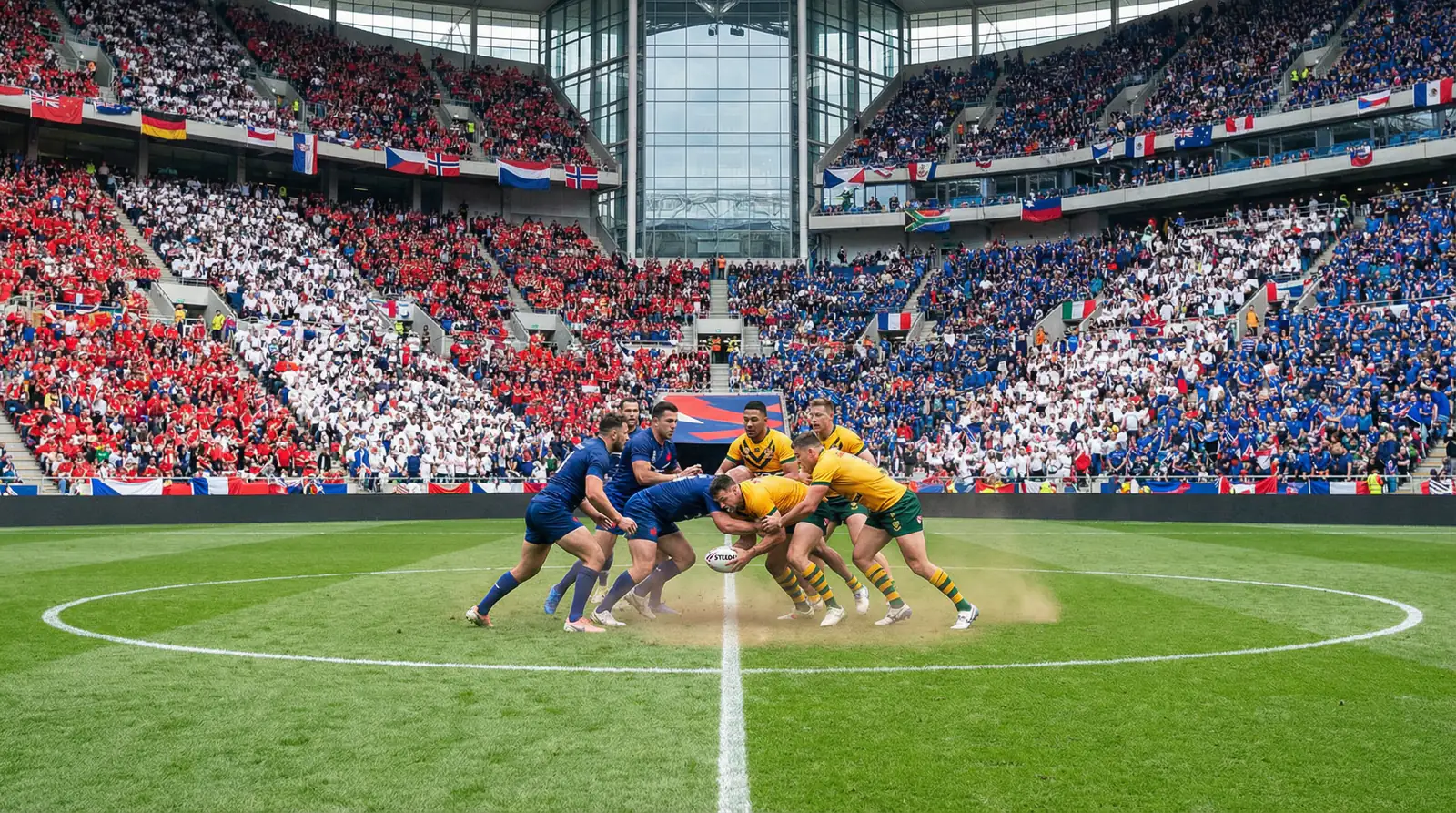

The Rugby League World Cup is the sport’s marquee international event, held every four years and dominated by the same country almost every time. Australia has won the tournament so often that the competitive question is less about who lifts the trophy and more about whether anyone can make the final interesting. For bettors, this creates a unique environment: a tournament where the outright market is essentially pre-decided, but where the secondary markets — group stage handicaps, top tryscorer, margins, and individual match props — contain genuine opportunities for those willing to look past the obvious.
This guide covers the structural dynamics of international rugby league, the competitive imbalance between tiers of nations, and where value exists in a tournament format that looks predictable on the surface but produces enough variance in individual matches to reward sharp betting.
The Shape of International Rugby League
International rugby league operates on a tiered system that is far more stratified than rugby union or football. The top tier — Australia, New Zealand, and England — accounts for the vast majority of competitive matches. The second tier — Tonga, Samoa, Papua New Guinea, Fiji, and France — has closed the gap in recent decades, particularly the Pacific Island nations whose players populate NRL and Super League rosters. The third tier — everyone else — is largely making up the numbers, providing the group-stage mismatches that inflate Australia’s scoring statistics but tell us nothing about the tournament’s eventual outcome.
This structure matters for betting because the bookmaker must set lines across a competition where the quality gap between teams varies from negligible (Australia vs New Zealand) to enormous (Australia vs a debutant nation). The lines in top-tier matches are priced with the same efficiency as a regular NRL fixture, because the bookmaker has substantial data on the players and the matchups. The lines in mismatches, however, are set with far less precision — the bookmaker simply does not have reliable form data for third-tier nations, and the handicap is more of a guess than a calculation.
Group-stage scheduling produces a predictable pattern: two competitive matches and one blowout per group. The blowout — Australia by 60, England by 40 — attracts casual bettors who want to pile on the favourite, but the real betting action is in the two competitive fixtures where the line is genuinely uncertain. Identifying which group-stage matches fall into the competitive category and which are foregone conclusions is the first step in building a World Cup betting plan.
Competitive Imbalance and What It Means for Outright Markets
Australia’s dominance of the Rugby League World Cup is not a narrative — it is a statistical fact. The Kangaroos have won the majority of all tournaments played, and their defeats in the competition can be counted without needing both hands. This creates an outright market that is essentially a two-question exercise: first, is there any realistic challenger this cycle, and second, is the price on that challenger sufficient to justify the risk?
New Zealand and England are the perennial alternatives. The Kiwis have the NRL talent base to compete and have occasionally beaten Australia in one-off matches, though translating that into a tournament run is a different challenge. England have home advantage when the tournament is hosted in the United Kingdom and a Super League core supplemented by NRL-based players, but they have historically underperformed in knockout stages against southern hemisphere opposition.
The Pacific Island nations have introduced genuine uncertainty into the middle rounds of recent tournaments. Tonga’s emergence as a competitive force — fuelled by NRL stars choosing to represent their heritage nation rather than Australia or New Zealand — has reshuffled the power dynamics below the top two. A Tongan side featuring a squad of current NRL first-graders is not a novelty act; it is a legitimate threat to win any match outside of the final. Samoa’s run to the 2021 final underscored this shift emphatically.
For outright betting, the practical approach is to assess whether the tournament favourite (almost always Australia at $1.50–$2.00) represents value at that price, or whether the second-tier prices on New Zealand ($4.00–$6.00) or England ($6.00–$10.00) offer a better return on investment when weighted by probability. In most cycles, the honest answer is that Australia is appropriately priced and the outright market is not where the edge lies. The value is elsewhere in the tournament.
Where Value Exists in World Cup Betting
If the outright market is a dead end for most bettors, the match-level markets are where the World Cup comes alive. Group-stage matches between second-tier nations produce the softest lines in the tournament because the bookmaker’s data on these teams is thin, the form guide is based on infrequent international fixtures, and the personnel can shift dramatically from one tournament cycle to the next.
Consider a group-stage match between Tonga and Papua New Guinea. Both teams feature NRL-quality players, but the bookmaker’s assessment of their relative strength is based on a handful of test matches played over the preceding four years, some of which may have featured entirely different squads. The line in this match is inherently imprecise, and any bettor who has closely tracked the NRL form of the individual players in each squad has an informational advantage over the market.
Player-level analysis is the key to unlocking World Cup value. Because international rosters are assembled from NRL and Super League clubs, you can evaluate each squad member’s current form, fitness, and role at club level and project how they will function in the national team structure. A Samoan squad featuring five NRL starting forwards and a genuine halfback is measurably stronger than a Samoan squad whose best players have declined to participate or are carrying injuries. These roster-level assessments are available to anyone who follows the NRL, but the bookmaker’s model may rely on historical international results that do not reflect the current squad composition.
Handicap markets in mismatches deserve careful handling. When Australia plays a third-tier nation, the handicap can sit at 50.5 or higher, and the question becomes whether the blowout will exceed or fall short of that number. The answer depends on game management: does the Australian coaching staff continue to push for tries in the second half, or do they rest key players and manage minutes ahead of more important fixtures? Tournament context matters here — if the match is Australia’s final group game and the knockout rounds are imminent, the second-half intensity typically drops, and the underdog covers the spread more often than the first-half performance would suggest.
Total points in World Cup mismatches tend to be set high but not always high enough. Third-tier defensive structures collapse under sustained pressure from elite attacking teams, and the resulting try-fests can produce combined scores above 70 or 80. However, the variance is enormous — some mismatches finish 60–0, others finish 46–4 — and the total points line in these games is essentially a coin flip. Unless you have a specific tactical reason to lean one way, passing on the totals market in World Cup blowouts is the disciplined choice.
Knockout-Stage Dynamics and Tournament Pressure
The knockout rounds of the Rugby League World Cup introduce a variable that club-level rugby league does not replicate: single-match elimination with weeks of preparation. Teams that have been together for the full group stage develop combinations and defensive patterns that improve with each match. The team that peaks in the quarter-finals is not necessarily the team that looked best in the group stage — it is the team whose coaching staff managed the build-up most effectively.
Knockout matches between top-tier nations are typically tight, low-scoring, and decided by small margins. The historical average combined score in World Cup semi-finals and finals is significantly lower than in group-stage matches, reflecting the increased defensive intensity and tactical conservatism of elimination football. Total points markets in knockout rounds should be approached with an unders bias unless the matchup features a clear mismatch that has somehow survived to the late stages.
Home advantage in a World Cup operates differently from club football. When the tournament is hosted in England, the English and — to a lesser extent — other northern hemisphere teams receive a crowd and travel advantage that is worth approximately 4–6 points on the line. When hosted in Australia, the Kangaroos’ already-dominant position is reinforced by home crowds, minimal travel, and familiar conditions. The host nation’s advantage in a World Cup is larger than a standard club home advantage because the visiting nations face longer travel, unfamiliar time zones, and the psychological weight of playing in a foreign country for three or four consecutive weeks.
The Match That Matters More Than the Final
The most valuable betting match in any Rugby League World Cup is not the final. It is the semi-final between the second- and third-strongest teams — typically New Zealand against England, or one of those sides against an emergent Pacific Island nation. This match is where the market is least certain, the line is most debatable, and the emotional intensity produces variance that the odds struggle to capture.
The final itself, almost always featuring Australia, tends to be a procession or at best a competitive first half followed by an Australian pullaway. The line is set with high precision because the bookmaker has absorbed the full tournament’s data, and the overround is tighter than at any other stage of the competition. The edge has been squeezed out by the time the trophy is on the line.
The semi-finals, by contrast, are priced earlier in the tournament timeline, with less data, more uncertainty about team form and fatigue, and more emotional volatility. A team that scraped through a brutal quarter-final three days earlier is carrying physical and psychological fatigue that the line may not fully reflect. A team that cruised through its quarter is fresh but potentially underprepared for the intensity jump. These dynamics are difficult to model precisely, which is exactly why they produce the kind of inefficiency that sharp bettors exploit.
Save your biggest World Cup bets for the semi-finals. Let the casuals have the final.
