

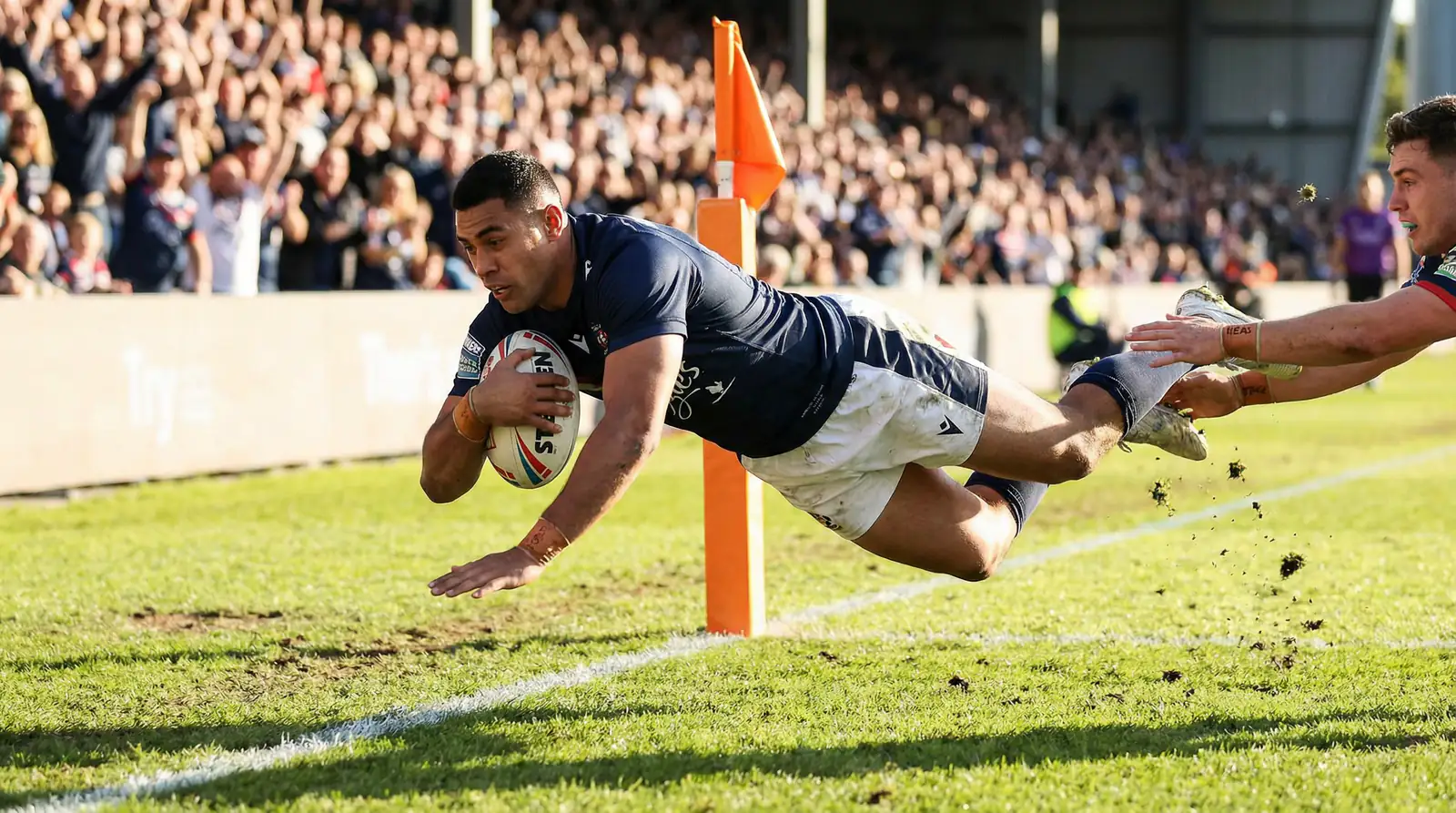

Anytime tryscorer is the most popular exotic bet in rugby league, and for good reason — it gives you a direct stake in the most exciting moments of the game without requiring you to predict the match result. Every time your selected player touches down, you win, regardless of whether his team is ahead or behind. That simplicity, combined with the thrill of watching a specific player in every attacking set, makes it irresistible to casual punters.
It also makes it a market where bookmakers take an enormous margin, which means finding genuine value requires more discipline and analysis than most bettors bring to the table.
How Bookmakers Price Anytime Tryscorer Markets
The pricing of anytime tryscorer markets starts with historical try-scoring rates by position and player. A fullback who has scored 15 tries in 24 games has a per-game rate of 0.625, which translates to a fair-value decimal price of approximately 1.60 for an anytime try in any given match. The bookmaker then applies their margin — typically 15% to 25% on tryscorer markets — which shortens the price to somewhere around 1.35 to 1.45. The resulting odds are lower than what you would expect from a pure probability standpoint, and this margin compression is where the house makes its money.
The margin on anytime tryscorer markets is significantly wider than on match markets, and for good reason. Tryscorer bets are overwhelmingly placed by recreational punters who are attracted by the engagement factor rather than seeking value. This customer profile allows bookmakers to charge a premium without losing volume. The average punter placing a five-dollar tryscorer bet does not calculate the implied probability — they pick their favourite player and enjoy the game. The bookmaker profits not from being smarter than the bettor on who will score, but from the structural margin built into every price.
For value-seeking bettors, the implication is clear: overcoming a 20% margin requires a substantial edge in identifying which players are more likely to score than the market suggests. A slight hunch that a player might have a good game is not sufficient. You need specific, quantifiable reasons to believe a player’s try-scoring probability exceeds the implied probability by enough to overcome the house edge.
Positional Try-Scoring Rates and Where Value Hides
Try-scoring in rugby league is not evenly distributed across positions. Wingers and centres score the most tries on average because they operate on the edges where space is most available and attacking plays are designed to finish. Fullbacks score frequently because they insert themselves into the attacking line and finish support plays. Props and second-rowers score least often because their primary role is running the ball into traffic in the middle of the field, though they do score from close range when their team is camped on the opponent’s line.
The bookmaker’s pricing reflects these positional averages, so simply backing wingers because they score more tries is not a strategy — it is already priced in. Value in anytime tryscorer markets comes from situations where a specific player’s try-scoring probability in a specific match exceeds their general positional average, and the bookmaker’s price has not fully adjusted.
Several factors can push a player’s probability above their average. A favourable matchup — a prolific winger facing a team with weak edge defence — increases the likelihood of that player finishing tries on his side of the field. A team’s recent tactical pattern might be funnelling more attacking plays to one side than the other, creating additional opportunities for the player on that edge. And a player returning from injury who has been available for selection but has not yet scored might have drifted in the market to a price longer than his underlying probability warrants, because the market weights recent non-scoring games too heavily.
The reverse also applies. A player on a try-scoring streak will see his anytime price compress below fair value as recreational money pours in. A winger who has scored in four consecutive games might be priced at 1.40 when his true per-game probability supports a price closer to 1.65. The market overreacts to streaks in both directions, and the informed bettor profits by fading streaks rather than chasing them.
Comparing Odds Against Historical Data
The most rigorous approach to anytime tryscorer betting involves building a database of try-scoring rates by player and position, then comparing those rates against the bookmaker’s implied probabilities match by match. This is labour-intensive but effective, because it converts an emotional market into a data-driven exercise.
Start by recording each player’s try-scoring rate over a meaningful sample — ideally 20 or more games to smooth out variance. Calculate the per-game rate and convert it to an implied fair price. Then compare this fair price against the bookmaker’s offered odds. If the bookmaker is offering 2.50 on a player whose historical rate implies a fair price of 2.10, the market is offering value. If the bookmaker offers 1.60 on a player whose rate implies 1.80, the price is short of value and you should pass.
Adjust the historical rate for matchup-specific factors. If the player’s team is a heavy favourite, they are likely to have more attacking possessions, which increases their try-scoring probability above their season average. If the opponent’s edge defence ranks in the bottom four of the competition, the probability increases further. Conversely, if the match is expected to be a low-scoring grind in wet conditions, even a prolific tryscorer’s probability drops below their average.
This adjustment process is not precise — you cannot model try-scoring probability to two decimal places — but it does not need to be. The anytime tryscorer market carries enough margin that your adjustment only needs to be directionally correct and roughly the right magnitude. If your adjusted probability is meaningfully higher than the implied probability from the bookmaker’s odds, the bet is worth considering. If the difference is marginal, the house edge is likely to swallow any edge you think you have. See also first tryscorer betting.
The Long Game: Why Most Tryscorer Bettors Lose
The uncomfortable arithmetic of anytime tryscorer betting is that the margin is simply too wide for most bettors to overcome. A 20% house edge means you need to identify players whose try-scoring probability exceeds the market’s implied probability by at least 20% to break even. Finding that level of mispricing consistently requires either exceptional analytical skill or access to information that the broader market does not have.
Most recreational tryscorer bettors lose money not because they pick the wrong players, but because they bet too frequently on a market where the structural disadvantage is steep. A bettor who places an anytime tryscorer bet on every NRL match — eight bets per round across 27 rounds — will place over 200 tryscorer bets per season. Even with reasonable player selection, the cumulative margin drag on 200 bets at a 20% overround is punishing. The mathematics practically guarantee a loss unless the bettor is operating with a substantial and sustained analytical edge.
The solution is selectivity. Instead of betting tryscorers every round, restrict your action to the handful of matches per season where your analysis identifies clear mispricing. A player whose rate supports a price of 2.00 but is being offered at 2.80 because of a recent scoring drought is a genuine value play. A winger facing the worst edge defence in the competition at a price that does not reflect the matchup advantage is another. These opportunities exist, but they arise perhaps once or twice a month rather than multiple times per round.
Tryscoring Is a Game of Inches and Randomness
The final truth about anytime tryscorer betting is that try-scoring is inherently random at the individual level. A winger can be in the perfect position three times in a game and not score because of a knock-on by his centre, a forward pass in the build-up, or a last-ditch tackle that forces him into touch centimetres from the line. Another winger might score a hat-trick from three lucky bounces and a defensive miscommunication that had nothing to do with his own skill.
This randomness does not mean tryscorer betting is pointless — it means the variance is high and the feedback loop is unreliable. A lost tryscorer bet does not necessarily mean your analysis was wrong, just as a winning bet does not confirm it was right. The only way to evaluate your tryscorer betting is over a sample of at least 50 to 100 bets, measured by whether you achieved positive expected value relative to the closing prices, not by whether any individual player crossed the try line.
Approach tryscorer betting with statistical rigour, ruthless selectivity, and realistic expectations about the margin you are fighting against. If you can do that, the market’s most popular exotic bet can become a quietly profitable corner of your rugby league wagering. If you cannot resist the urge to bet on every game, the house will thank you for your contributions. Anytime tryscorer betting on rugby league betting.
