

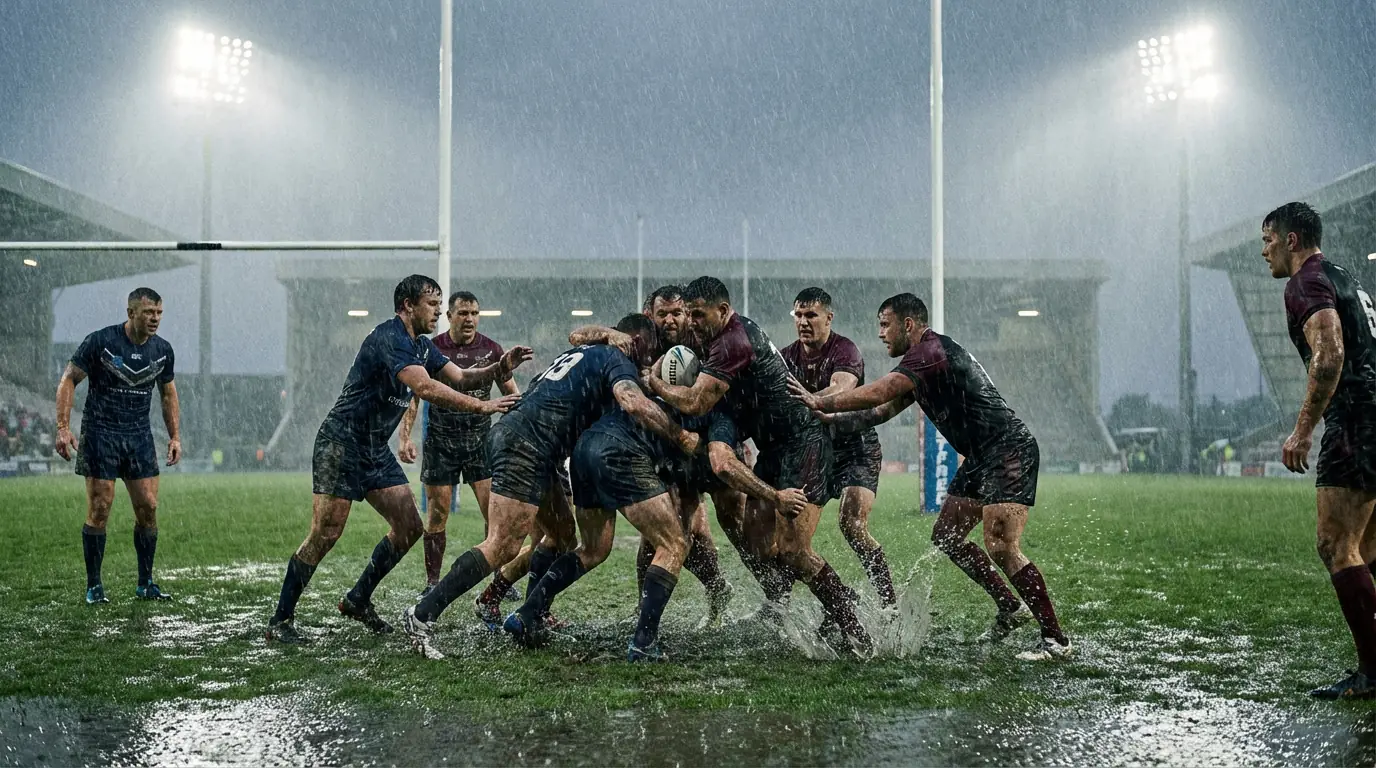

Rugby league is played outdoors, on grass, in conditions that range from tropical downpours in North Queensland to biting English winters in Wigan. Unlike sports played in controlled environments, the weather directly changes how a rugby league match unfolds — and by extension, how you should bet on it. Ignoring the forecast is one of the most common and easily avoidable mistakes in rugby league wagering.
The relationship between weather and scoring in rugby league is not subtle. It is measurable, repeatable, and — most importantly for bettors — frequently underpriced by the market.
Rain: The Great Score Compressor
Rain is the single biggest weather variable in rugby league betting. Wet conditions reduce scoring in ways that are both obvious and less immediately apparent. The obvious part is that a slippery ball leads to more handling errors, which means more turnovers, fewer sustained attacking sets, and fewer tries. The less obvious part is how rain changes tactical approach: coaches shift to a kick-heavy, territory-based game plan when the surface is wet, prioritising field position over expansive attack.
Historical data consistently shows that NRL matches played in heavy rain produce totals roughly 8 to 14 points below the seasonal average. In the Super League, where pitches are often heavier and drainage less advanced than in Australia, the effect can be even more pronounced. This is significant because bookmaker totals lines are typically set based on team averages and recent form, and those averages are calculated predominantly from dry-weather games since that is the more common condition.
The practical angle for bettors is straightforward: when rain is forecast during a match — particularly persistent rain rather than a brief shower — the under on total points becomes more attractive. But there are layers to this. If the rain is forecast to arrive in the second half, the first-half scoring might proceed normally while the second half compresses. Some bettors target second-half unders specifically in these scenarios. If the rain has been falling for hours before kickoff and the pitch is already saturated, the effect starts from the opening whistle and impacts the entire match.
One trap to avoid is assuming that all rain games produce low scores. Brief showers that clear before kickoff may leave the ball dry and the surface only mildly affected. Modern stadiums with excellent drainage — like several newer NRL venues — handle rain better than older grounds. Context matters more than a simple rain icon on a weather app.
Wind: The Invisible Disruptor
Wind is harder to quantify than rain but arguably more disruptive to specific markets. A strong crosswind or headwind does not necessarily reduce total scoring — it depends on how the teams adapt — but it wreaks havoc on goalkicking accuracy, which directly impacts handicap and margin outcomes.
In rugby league, a converted try is worth six points (four for the try, two for the conversion). A missed conversion means only four points from that scoring event. Over a match where each team scores three or four tries, two or three missed conversions can shift the final margin by four to six points. That is often the difference between covering a handicap line or falling short. When wind speeds exceed 30 kilometres per hour, conversion accuracy drops noticeably, and bettors should factor this into handicap assessments.
Wind also disrupts the kicking game more broadly. Teams that rely on long spiral kicks to gain territory or force dropouts find those kicks less reliable in swirling conditions. This can neutralise a tactical advantage that the bookmaker has priced into the line. If one team’s game plan depends on a dominant kicking halfback controlling field position, a strong wind forecast should give you pause before backing them at their market price.
The tricky part about wind is that stadium orientation and architecture matter enormously. An open-ended ground funnels wind through the pitch. An enclosed stadium with a closed roof eliminates the variable entirely. Knowing the venue and its exposure to wind is part of the homework that separates informed bettors from those who check the weather but miss the context.
Heat and Humidity: The Fatigue Factor
Extreme heat rarely gets the attention it deserves in rugby league betting analysis. Matches played in temperatures above 30 degrees Celsius — common in the early rounds of the NRL season and in Queensland-based games through summer — place enormous physical demands on players, particularly forwards who carry the ball into contact repeatedly.
The primary effect of heat is accelerated fatigue, which manifests in the final quarter of matches. Teams that are evenly matched through 60 minutes can see one side collapse physically in the last 20, leading to a burst of late scoring that inflates the total and distorts the margin. This is particularly relevant for live betting, where odds adjust based on the current score without always adequately pricing the likelihood of a late fatigue-driven blowout.
Humidity compounds the heat effect. A 32-degree day with 80% humidity in Townsville is a different physical challenge than a dry 35-degree day in Sydney’s west. Humid conditions impair the body’s cooling mechanisms, leading to earlier onset of fatigue and higher injury risk. Teams travelling from cooler southern climates to play in tropical conditions often struggle physically, which is one reason why North Queensland and several other northern-based teams historically perform better at home during the early-season heat. See also home advantage.
For bettors, the practical takeaway is that extreme heat games tend to see scoring increase in the second half relative to the first. If you are betting totals, the over becomes more attractive in genuinely hot conditions. If you are betting handicaps, consider whether the team you are backing has the bench depth to rotate players effectively in the heat — sides with a deep forward rotation cope significantly better than those relying on a small group of fatigued big men.
Forecasts, Timing, and the Betting Market’s Blind Spot
One of the most exploitable edges in weather-related betting is timing. Most recreational bettors place their bets well before kickoff, often when they first see the round’s fixtures — and at that point, the weather forecast is either unknown or vague. Bookmakers set their opening lines based on expected conditions, but they cannot perfectly predict what will happen meteorologically 48 or 72 hours out.
The edge lies in acting on updated forecasts closer to game time. If a match was priced on Monday with clear skies expected and a storm system rolls in by Friday afternoon, the totals line may not have adjusted fully by the time you place your bet. Bookmakers do react to weather, but their adjustments tend to be conservative — a point or two on the total, perhaps a minor tweak to the handicap. If the conditions are genuinely severe, the market price may still underestimate the impact.
The reverse also applies. If a match was expected to be played in rain and the forecast clears, the under line that bettors have hammered may now represent poor value, while the over — priced to account for wet conditions that will not materialise — could offer an opportunity. Monitoring weather updates in the 12 to 24 hours before kickoff is one of the lowest-effort, highest-reward habits you can develop.
Australian bettors watching the NRL have an additional nuance to consider: the dew factor. Evening matches in certain parts of Australia see heavy dew settle on the pitch from the second half onwards, creating conditions similar to light rain even when no precipitation occurs. This is well-known locally but sometimes overlooked by international bookmakers and bettors who have not studied venue-specific conditions.
Venue-Specific Weather Profiles
Not all rugby league venues are created equal when it comes to weather impact. Some grounds are notorious for conditions that favour certain outcomes, and knowing these tendencies gives you an informational edge that the average bettor lacks.
In the NRL, venues in Far North Queensland like Qld Country Bank Stadium in Townsville deliver heat and humidity that suppress visiting teams’ second-half performance with predictable regularity. CommBank Stadium in western Sydney sits in a geographic basin that traps heat, making afternoon games there significantly hotter than coastal venues. Conversely, matches in Melbourne during the winter can produce cold, windy conditions that NRL teams based in warmer climates find uncomfortable.
Super League venues carry their own weather signatures. Headingley in Leeds is exposed to wind that blows across the pitch, affecting kicking accuracy. The Halliwell Jones Stadium in Warrington, while modern, can see heavy pitch deterioration in extended wet spells during the English winter. Wigan’s Brick Community Stadium handles rain reasonably well, but cold snaps in January and February create hard, fast pitches that change the game’s tempo and suit certain playing styles.
Building a mental — or literal — database of how specific venues interact with weather conditions is one of those unglamorous edges that compounds over time. It will not win you any individual bet by a huge margin, but it will tilt the odds slightly in your direction across hundreds of wagers.
The Forecast Is Part of Your Betting Toolkit, Not the Whole Thing
Weather is a factor, not the only factor. A common mistake among bettors who discover the weather edge is to overweight it, turning every game with a rain icon into an automatic under bet. The weather interacts with team quality, playing style, and tactical matchups. A team that runs a forward-dominant, territory-based game plan may actually be less affected by rain than an expansive side that relies on width and offloads. Two defensive teams playing in the dry might produce a lower-scoring game than two attacking teams in the rain.
The correct approach is to incorporate weather as one variable in a multi-factor assessment. Start with your analysis of the teams, the matchup, and the expected game flow. Then check the forecast and ask whether the conditions change your baseline expectation enough to shift the value calculation. Sometimes they will, and you gain an edge. Sometimes the weather is a non-factor, and your analysis stands unchanged.
What weather analysis does most effectively is identify specific games where the market has mispriced the conditions. Those opportunities are not available every round, but when they appear — a sudden storm forecast for a game with a high totals line, or blistering heat for a match between two teams with thin forward rotations — they represent some of the cleanest edges available in rugby league betting. Weather impact betting on rugby league betting.
