

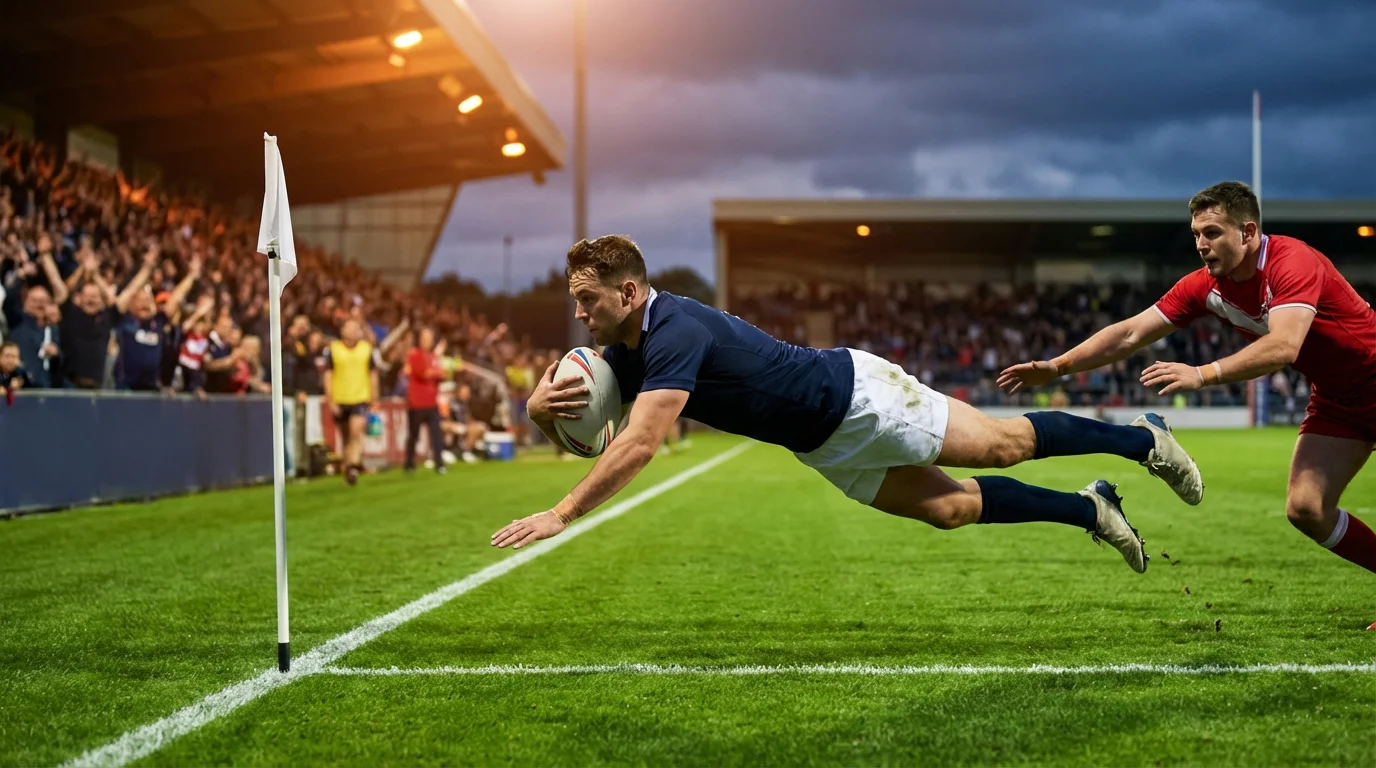

First tryscorer markets are the glitter of rugby league betting — shiny, exciting, and responsible for more lost money than any other single market type. The allure is obvious. Pick one player, watch the opening exchanges with heightened intensity, and collect at odds that routinely sit between $5.00 and $20.00. But the maths beneath the surface is unforgiving, and most bettors approach this market with a confidence that their edge does not justify.
That does not mean first tryscorer betting is a guaranteed loss. It means you need to understand what you are actually betting on: a high-variance, high-margin market where discipline and positional analysis matter far more than chasing your favourite winger. This guide breaks down which positions and player profiles offer genuine value, how variance governs your results, and what realistic profitability looks like if you treat this market seriously.
Which Positions Score the First Try?
The instinct is to back a winger or fullback — players who finish tries and whose names appear on the scoresheet most often. The instinct is not wrong in absolute terms, but it is incomplete. Wingers and fullbacks do score the most tries across a season, but the bookmaker knows this too, and their odds reflect it. A winger priced at $7.00 to score first is not a value bet simply because wingers score a lot of tries. The price already accounts for the frequency.
The more productive question is: which positions score the first try of a match at a rate the market undervalues? Historical NRL data shows that centres and second-rowers score the first try at a slightly higher rate than their season-long try tallies would predict. The reason is structural. Early in a match, defensive lines are set, edge defence is organised, and wingers receive fewer clean opportunities. The first try often comes from a short-range play — a crash ball through the centres, a second-rower barging over from dummy half, or a forward powering across from close range after a sustained set near the line. These are not the highlight-reel plays; they are the working-class tries that open scoring in a disproportionate number of matches.
Hookers and dummy-half runners represent another undervalued category. A hooker who darts from the ruck close to the line has a genuine chance of sniping the first try, particularly against teams with slow marker defence. The NRL has seen a generation of mobile hookers — players whose try-scoring rates from dummy half are historically high — priced at $15.00 or more in first tryscorer markets. At those odds, even a modest strike rate generates positive expected value over a large sample.
Halfbacks and five-eighths score the first try less frequently than outside backs, but when they do, the odds are generous. A quality playmaker priced at $12.00–$15.00 who runs a structured short-side play off early scrums can represent legitimate value, particularly against teams whose edge defence has been identified as a weakness in film review. See also anytime tryscorer betting.
Player Profiles That Offer the Best Value
Beyond position, individual playing style determines first tryscorer probability more precisely than the jersey number on a player’s back. The profiles that consistently outperform their market odds share common characteristics.
High-involvement runners — players who carry the ball frequently in attacking zones — generate more opportunities by sheer volume. A centre who averages 15 runs per game, with a significant portion in the opposition’s 20-metre zone, creates more first-try chances than a winger who touches the ball eight times and relies on set plays to score. Volume is the bedrock of first tryscorer value.
Players in structured set plays near the line — particularly those used as first or second receivers in plays off scrums and penalties close to the try line — have a disproportionate chance of scoring early. Coaches design these plays to exploit specific defensive tendencies, and the first set piece of the match is often the most rehearsed and most likely to produce a try. Identifying which player is the primary target in a team’s close-range set plays is a genuine analytical edge that most casual bettors do not pursue.
Returning players from injury or suspension sometimes receive an unexpected boost. Coaches may design early plays to involve a returning star — both to boost confidence and because the opposition may not have prepared for that player’s inclusion. This is a softer, less quantifiable edge, but it adds texture to your assessment when all other factors are balanced.
The profiles that consistently underperform include pure finishers on the wing who rely on overlap plays (these take time to develop and rarely produce first tries), and forwards whose try-scoring comes exclusively from late-game fatigue situations when defensive lines are broken. The first try of a match is scored when defences are fresh and organised, which makes it a fundamentally different scoring environment from the try scored in the 75th minute.
Variance: The Unavoidable Reality of First Tryscorer Betting
If you bet on first tryscorer markets, variance is not a risk factor — it is the defining characteristic. At average odds of $8.00–$12.00, you will lose the vast majority of individual bets. A bettor with a genuine edge might expect to show a profit over 200–300 bets, but any sample smaller than that is dominated by noise. Losing streaks of 15–20 bets are not just possible; they are mathematically expected even with positive expected value.
This has psychological consequences that most bettors underestimate. After twelve consecutive losses at $8.00 average odds, you have lost a significant chunk of your bankroll, and the temptation to either chase losses with bigger stakes or abandon the market entirely is intense. Both reactions are wrong. Chasing destroys bankroll management. Abandoning the market throws away the work you have done to identify value. The correct response is to continue at the same stake size, trusting that your edge — if it genuinely exists — will compound over the long run.
The practical implication is that first tryscorer betting demands smaller unit sizes than other markets. If your standard bet on handicaps or totals is 2% of bankroll, your first tryscorer bet should be 0.5–1% at most. This slower burn preserves your bankroll through the inevitable cold streaks and gives your edge time to manifest. Bettors who stake first tryscorer bets at the same level as their head-to-head bets are structurally exposing themselves to ruin regardless of whether they have an edge.
Tracking results over time is essential but requires patience. Record every bet with the player, position, odds, and outcome. After 100 bets, calculate your return on investment (ROI). A positive ROI of 5–10% over 100 first tryscorer bets is an excellent result — and it will still feel like you are losing, because your win rate will sit at roughly 12–15%. The disconnect between perceived and actual performance is one of the hardest aspects of high-odds betting to manage emotionally.
Long-Term Profitability Expectations
Let us be blunt: the bookmaker margin on first tryscorer markets is the highest of any standard rugby league market. Overrounds of 130–150% are common, meaning the bookmaker is pricing in a 30–50% edge before you even place a bet. Compare that to the 4–6% overround on head-to-head or the 3.5–5% on handicaps, and the scale of the challenge is clear.
To overcome a 140% overround, you need to identify players whose true first tryscorer probability is significantly higher than the implied probability of their odds. If a player is priced at $10.00 (implied probability 10%), you need to believe their true probability is closer to 14–15% to have a meaningful edge after accounting for the margin. That is a 40–50% error in the bookmaker’s assessment, which happens — but not often, and not across a wide range of players.
The realistic path to profitability in first tryscorer markets is narrow and selective. Rather than betting every match, focus on the 3–5 matches per round where your analysis identifies a specific player whose profile, matchup, and set-play involvement create a genuine discrepancy with the market price. Betting 5–8 first tryscorer selections per week across a full NRL round, as many recreational bettors do, almost guarantees long-term losses. The edge exists only at the margins, and volume dilutes it.
Same-game multis that include a first tryscorer leg deserve particular caution. Bookmakers compound their already-high margins in these products, and the correlation between a first tryscorer pick and other legs (like the match winner) is priced in imperfectly — sometimes in your favour, often against. Unless you have a specific reason to believe a correlated multi offers genuine value above the margin, standalone first tryscorer bets are the cleaner proposition.
The Try That Tells You Everything
There is a moment in almost every rugby league match that reveals more about first tryscorer markets than any statistical model. It comes in the opening ten minutes: the first genuine attacking set inside the opposition 20-metre zone. Watch who carries the ball on the play-the-ball before the try is scored. Watch which side of the field the coach has chosen to attack. Watch whether the try comes from a structured set piece or a broken-play scramble.
Over time, these observations build a library of tendencies that no database captures fully. You start to notice that certain coaches always target the left edge in their opening set plays. You learn which hookers dart from dummy half on the third tackle near the line. You recognise that a particular team’s short-side scrum play is designed for the second-rower, not the winger, despite the winger being priced shorter. This granular film study is the genuine edge in first tryscorer markets — not a magic formula, but an accumulation of pattern recognition that the odds compiler, setting prices across dozens of players per match, cannot replicate at the same depth.
If you are going to bet first tryscorer markets seriously, commit to watching the opening ten minutes of every match you bet on — not after, but during the following weeks. Treat it as ongoing research. The patterns repeat, the value reveals itself, and the try that looks lucky on the scoresheet is, more often than not, the product of a coaching plan that was visible to anyone paying close enough attention. First tryscorer betting on rugby league betting.
